
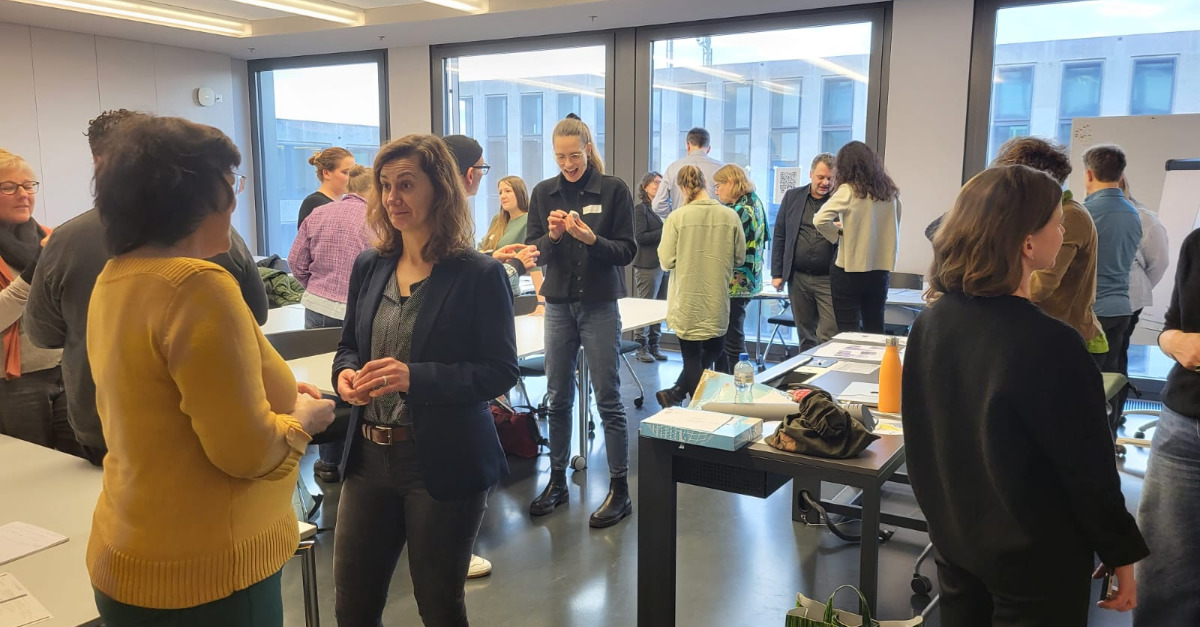
The joint research conference organised by SVEB and PH Zurich focused on the question: How can continuing education strengthen democracy? The afternoon offered interesting insights, engaging approaches and clear calls to action.
Fake news, a lack of trust in politics, news deprivation – these are tough times for democracy. This makes it all the more important to strengthen it. But what contribution can continuing education make to this?
The conference “Strengthening democracy through continuing education – perspectives, challenges and courses of action”, jointly organised by SVEB and the University of Teacher Education Zurich, was already in full swing.
Democracy is not a stable state
And Jana Trumann from the Ludwigsburg University of Education was already at the lectern. She addressed what is actually meant by political adult education. And she made it clear: democracy is not a stable state. It takes courage, in times of social upheaval, to get involved and participate despite resistance. She demonstrated that awareness of this can be raised in an accessible way using the example of a bakery that offered its staff workshops on intercultural education.
Neutrality cannot be the goal
‘Plurality and Controversy as a Quality: Professional Strategies for Action in Continuing Education’ was the title of Bernd Käpplinger’s lecture (Justus Liebig University Giessen). He asked: “Must and can continuing education be neutral?” and also highlighted the problematic nature of the term. His conclusion: democracy does not mean value neutrality. Käpplinger addressed concepts central to democracy such as the principle of moderation, the prohibition of indoctrination, and the principle of controversy. The latter, for example, states: what is controversial in science and politics must also appear controversial in the classroom.
Democracy thrives underground
Launching an initiative, voting, engaging in discourse, reflecting on one’s own behaviour: Rolf Gollob, an expert in democracy and human rights education, addressed in his keynote speech how we as individuals contribute to democracy. But it is not just these official actions, Gollob noted: democracy also takes place underground. And, drawing on the Council of Europe’s reference framework, he discussed which values, attitudes, abilities, skills and knowledge are necessary for democratic competence. Gollob sees democracy as a kind of toolbox for society: “Democracy provides us with tools that we must use.” And he added: “Good teaching promotes democracy.”
Exploring democracy through play
In the workshops that followed, several aspects were explored in greater depth.
In “Teaching Democracy with Serious Games”, Sabine Jenni demonstrated playful approaches to engaging with democracy education. For example, the game “Observer”, in which players must use a picture to work out what has happened (and which is in some way related to democracy). In other words, a sort of “Black Stories” for democracy. The workshop showed that engaging with the topic can also be entertaining.
But there was also laughter and active participation in the workshops “Democratic skills in my (professional) everyday life: opportunities, limitations and implementation options towards a lived democracy” (Rolf Gollob), “Participation as a key element of a democratic culture” (Samir Boulos, Nadine Ritzer) and “Between integration and (political) participation: language as an educational dimension” (Mi-Cha Flubacher), there was laughter and active participation.
The concluding panel discussion encouraged people to get involved. The final appeals to those present were: “Engage in political education with charm and courage!”, “Get involved!” and “Listen to one another!”