
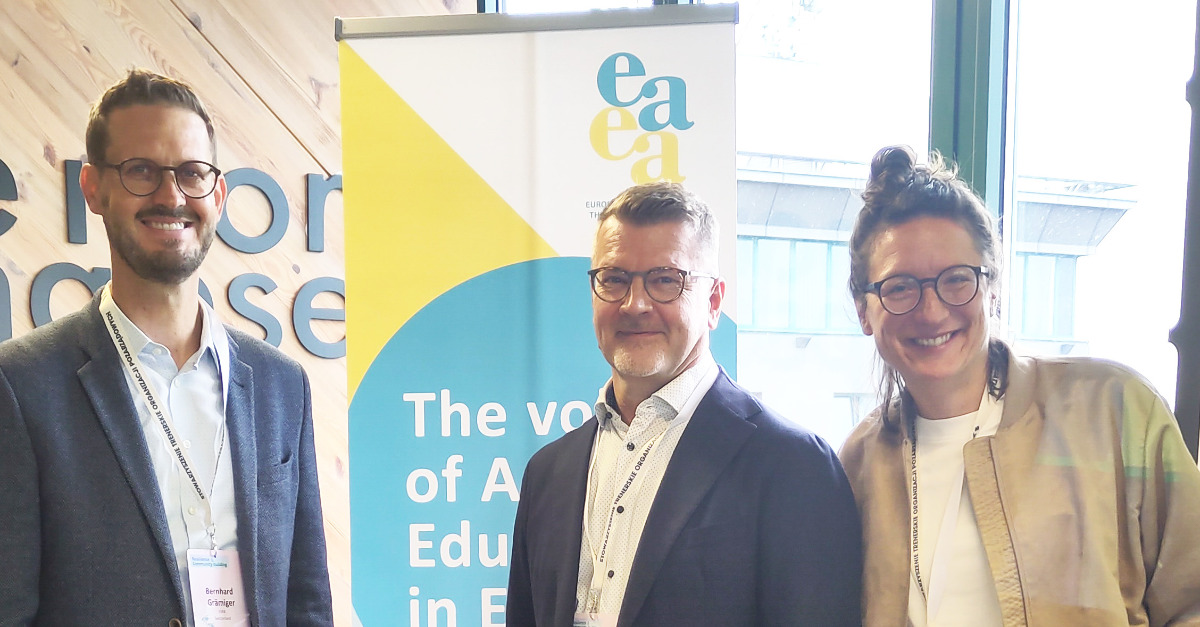
The annual conference of the European Association for Further Training (EAEA) was entirely devoted to resilience. Marianne Müller, Senior Project Manager for International Affairs and Research at SVEB, describes what she took away from Warsaw.
Text: Marianne Müller | Pictured: from left to right: Bernhard Grämiger (Director of SVEB), Lauri Tuomi (President of EAEA), Marianne Müller (Senior Project Manager
for International Affairs and Research at SVEB)
Bernhard Grämiger and Marianne Müller attended the General Assembly and the annual conference of the European Association for the Education of Adults (EAEA) in Poland on 9 and 10 June. SVEB is a founding member of the EAEA and is currently represented on the Executive Board.
The theme of this year’s conference was ‘Resilience and Community-Building’ and focused on how adult education can strengthen both individual resilience and social cohesion.
Resilience as a communal resource
In an era characterised by uncertainty, social fragmentation and rapid change, resilience is becoming increasingly important in adult education. This is not just about individual resilience, but also about resilience as a communal resource that arises through social relationships and mutual support.
The conference demonstrated that adult education can bridge the gap between individual and collective resilience by linking personal development with social participation – and empowering people not only to adapt to change but also to actively contribute to shaping resilient and supportive communities.
More than 120 adult education practitioners from across Europe discussed the topic at the conference. These practitioners operate in diverse contexts and face various challenges that necessitate resilience at both the individual and societal levels.
Regaining the capacity to act
Particularly striking, for example, was the report by a continuing education practitioner from Ukraine. The keynote address by Prof. Alicja Gałązka of the University of Silesia was also fascinating. Her research focuses, amongst other things, on positive psychology, well-being, mindfulness and resilience in educational contexts.
Prof. Alicja Gałązka describes resilience as the ability to cope with pressure, stress and crises and to regain the capacity to act after setbacks – also known as ‘bouncing back’. Resilience is linked to factors such as problem-solving skills, communication, self-efficacy, positive relationships and a sense of control over one’s own life. Resilience is an ability / skill that can be developed and strengthened – even in adulthood.
And this also highlights the role of adult education: adult education should not only impart knowledge, but also support people in dealing constructively with uncertainty, change and challenges. Resilience can be fostered through targeted educational and developmental processes, such as reflection, experience-based learning, social forms of learning, and the promotion of communication, conflict resolution and stress management skills.
Personal and Community Development
Resilience does not arise solely within the mind of the individual. It develops through the interplay of personal resources and supportive environments. That is why it is not enough simply to tell people: ‘Be resilient!’ Educational institutions, workplaces and communities must create conditions in which resilience can flourish.
During the conference, it became clear that adult education has a key role to play in this area – both in terms of fostering resilience and in strengthening society. This is because resilience education is always both personal development and community building. And it is essential to ensure that individuals and communities are equipped to face the challenges of the present day.