
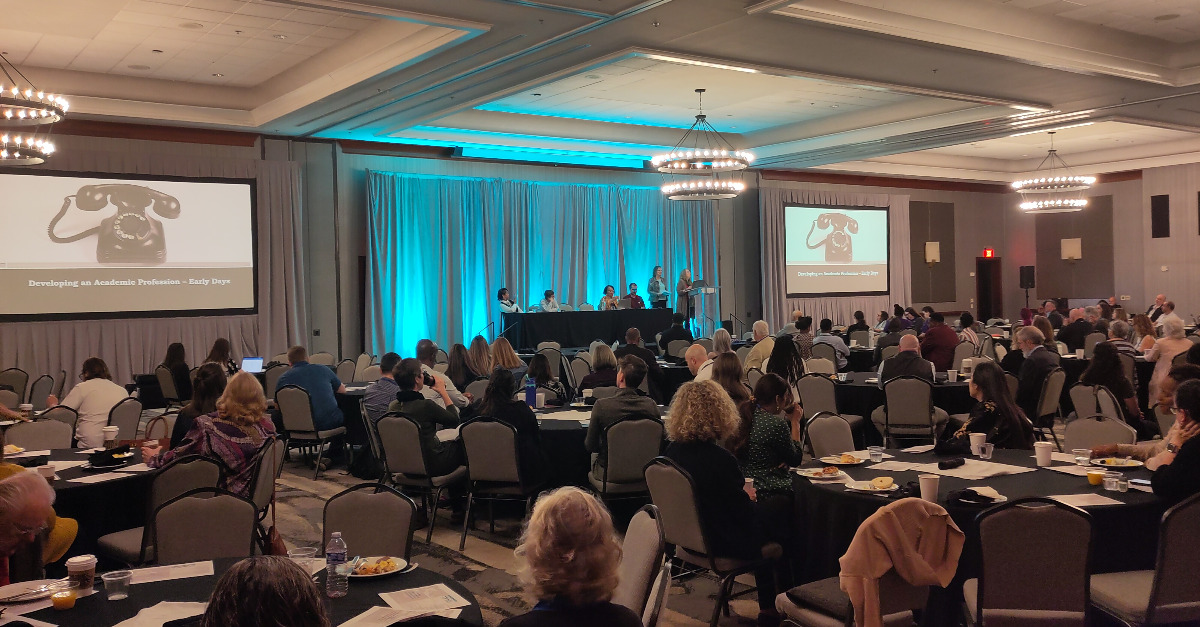
In October 2026, Marianne Müller, Senior Project Manager for International Affairs at SVEB, attended the annual conference of the American Association for Adult and Further Training (AAACE) in Chattanooga, Tennessee. The visit offered fascinating insights into adult education in the USA and highlighted the challenges and future issues that link further training on both sides of the Atlantic.
Report: Marianne Müller
The American Association for Adult and Further Training (AAACE) is the umbrella organisation for adult and further training in the USA. It brings together stakeholders from educational research and practice and is committed to the further development and strengthening of adult education in the USA. The annual conference provides a platform for the exchange of views on current developments, research findings and innovative approaches in adult education. I attended for the first time from 6 to 9 October.
Global challenges bring us together
I found it particularly fascinating how many topics discussed at the conference are also of concern to us in Switzerland and across Europe. These include, in particular, the impact of artificial intelligence on learning and teaching, the role of adult education in tackling the climate crisis, and the importance of education in the context of migration and social integration.
Concrete, practical solutions were also presented, such as AI-supported tools that assist people with low qualifications through the job application process or prepare them for entering the labour market through personalised learning programmes. Such approaches can also provide interesting inspiration for adult education in Switzerland. At the same time, my presentation on the GO model – the SVEB’s model for workplace-oriented learning – met with great interest at the conference.
Different framework conditions
Gaining an insight into the structures of the US further training system was also enlightening: in the US, community colleges – that is, public higher education institutions – and state universities play an important role in further training. The conference gave the impression that publicly funded adult education there is more closely linked to labour market policy and vocational qualifications than it is here in Switzerland.
Nevertheless, it faces similar challenges to those in many European countries. Financial pressure, in particular, is considerable: cuts to public funding and the associated uncertainties make it difficult to plan and develop educational programmes in the long term. At the same time, there are challenges linked to the current political situation in the USA. For instance, some interested parties had decided not to attend the conference because they feared difficulties entering or leaving the country. This showed me just how directly political conditions can also influence international professional exchange.
Great commitment and openness
I found the numerous personal encounters with AAACE members particularly enriching, and I was impressed by the great commitment with which many of them support their association – often on a voluntary basis. This enthusiasm for adult education and openness to international perspectives were palpable throughout the conference.
So too was the interest in adult education in Switzerland and Europe. It became clear to me just how much we can learn from one another – both on professional issues and on how we can effectively represent the interests of adult education to policymakers and the public.
For me, therefore, the conference was not only an opportunity to learn about new developments and approaches, but also to forge valuable contacts and explore possibilities for longer-term collaboration.
Continuing transatlantic exchange
The visit demonstrated to me once again the added value that international exchange brings to adult education – despite differences in education systems and political frameworks.
Cooperation across national borders not only broadens one’s own horizons, but also helps to strengthen adult education as a whole.